ADVERTISEMENT
“There is very limited experience handling this virus,” said Palacios, who was the director of the Center for Genome Sciences at the US Army Medical Research Institute of Infectious Diseases when he helped piece together how the virus moved from person to person. The study of the outbreak was published in 2020 in the New England Journal of Medicine.
“Probably we are having less than – I don’t know, I’m giving you a number, just for a ballpark number – 300 cases in history” of human to human transmission of Andes virus and about 3,000 Andes cases overall, Palacios said. He is also part of a group of experts advising on the ongoing cruise ship outbreak.


The researchers were able to show that the first patient, a 68-year-old man who attended a birthday party with about 100 other people, infected someone else after being in contact with them for only a few moments, on the way to the restroom.
Tracing the path of a killer
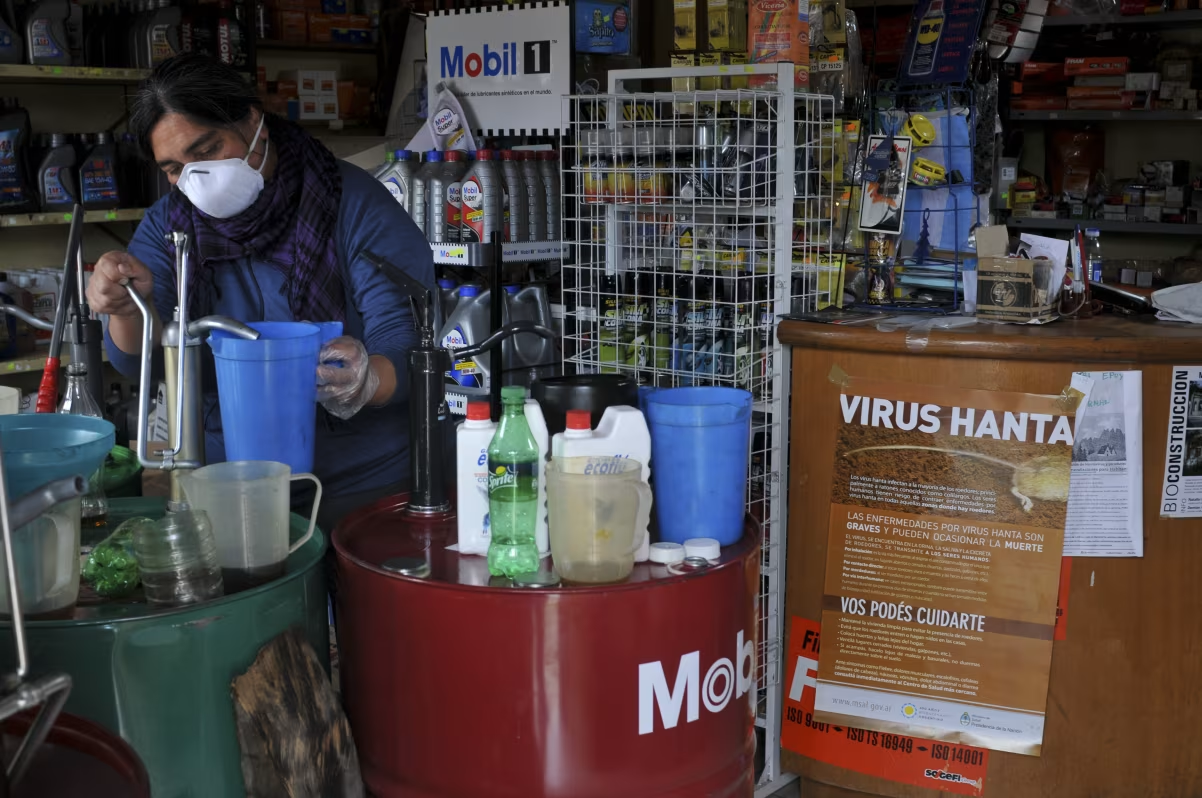
Around the world, including in the US Southwest, rodents are known to harbor hantaviruses. Humans are typically infected through contact with their urine, feces or saliva, sometimes when the virus becomes aerosolized during cleaning.
In most cases, hantaviruses result in what’s called a dead-end infection: A human gets infected after contact with animal droppings but doesn’t pass it on to anyone else.
Andes virus is an exception, however. It can spread between people, giving it the potential to spark outbreaks.


During the 90 minutes he was at the party, he infected five others, including two people sitting roughly a foot from him at the same table and two people who were sitting roughly 4 feet away from him at neighboring tables. The fifth person to catch the virus crossed paths with the patient only briefly on their way to the restroom.
Although all five patients were exposed at the November 3 birthday party, they didn’t start to show symptoms for another two to three weeks.
The second patient in the outbreak, a 61-year-old man described as having an active social life, infected six others before he died, 16 days after first showing symptoms.
His wife, who attended his wake with a fever, infected 10 others, who all became sick between 17 and 40 days after attending that event.
An additional 12 people were infected after contact with previously infected patients.

A limited window for spread
In the Epuyen outbreak, more than 80 healthcare workers were exposed to patients with symptoms, but none was directly infected themselves, though very few used any personal protective equipment. There were two infected healthcare workers at the local rural hospital, a smaller facility, which may have been the first to see sick patients.
The limited spread among healthcare workers in the Epuyen outbreak speaks to the short window of time that a person may be infectious, experts said.
“This is not Covid. This is really not Covid. It’s not even influenza. It’s an unusual person-to-person event, and it might have happened because, perhaps, of a closed environment on a ship,” said Dr. Lucille Blumberg, an infectious disease specialist who is the former deputy director of the National Institute for Communicable Diseases in South Africa, of the cruise ship outbreak.
Blumberg was consulted Friday about the deaths related to the Hondius and another seriously ill passenger who had been on a different part of the ship, who was medically evacuated to Ascension Island, a British territory that sits in the Atlantic Ocean about a thousand miles from the west coast of Africa, and then flown to South Africa. He is intensive care on a ventilator but is improving, Blumberg said.
She said they would be following the passengers on the Hondius closely. They will each need to be monitored for at least 45 days, she said.
On Wednesday, the World Health Organization confirmed that a man in Switzerland had tested positive for the virus after getting off the Hondius and flying home.
Contact tracing is underway for people who were on flights with ill passengers from MV Hondius. Oceanwide Expeditions, the cruise operator, said it is still working on the details of who embarked and disembarked from the ship since March.
“We expect to share details on that in the coming days,” said Piet Hein Coebergh, a spokesperson for the company, which is based in the Netherlands.
So far there are eight illnesses connected to the ship, three confirmed cases of hantavirus and five suspected cases, according to WHO.
“People come off and on at the ports,” Blumberg said. “They don’t stay for the whole voyage.
“I think we’ll see other cases,” she said.
A floating outbreak
Many of the passengers were serious birdwatchers who had been on expeditions in South America before joining the cruise, Blumberg said.
For that reason, avian influenza was one of her initial guesses as to the cause of the illnesses. She also suspected that people might have legionella infections, which can cause pneumonia.

After two rounds of tests were negative for those and other suspected pathogens, Blumberg said, she called the lab at the Centre for Emerging Zoonotic and Parasitic Diseases at the National Institute for Communicable Diseases and told them to test for hantavirus.
After it was positive, she called the hospital that had treated the ill wife of the first passenger, who died, and asked whether it had saved any test tubes of her blood. It had, and that patient, too, tested positive posthumously for hantavirus. By Monday, gene sequencing determined that it was the Andes strain.
Blumberg said that for herself and her colleagues, it has been a round-the-clock effort; she was up at 4 a.m. Wednesday. She said they are actively working on tracing the contacts of patients who were evacuated to South Africa for medical care. They are also working on sequencing the entire genome of the virus, which should help pinpoint where it came from and whether it has developed new mutations.
They’ve had global cooperation from the scientific community, all spearheaded by WHO, she said, and the international group working on the outbreak has already held three calls.
“We really have almost no experience with Andean hanta,” Blumberg said.
Other infectious disease experts like Dr. William Schaffner, at Vanderbilt University, say the situation on the Hondius doesn’t have them worried, but they are very interested.
“I am transfixed,” Schaffner said. “It’s an extraordinarily unusual circumstance where there’s hantavirus infection on a boat, and I’m even impressed that they’ve made this diagnosis.
“It’s serious, and for us, scientifically, it has all these other curiosities about location and behaviors of new hantavirus variants,” Schaffner said.
“So there are lots of scientific issues, there are public health issues, there are issues of, how do you deal with seriously ill people on a cruise ship who have a communicable disease in the middle of the ocean?”
ADVERTISEMENT